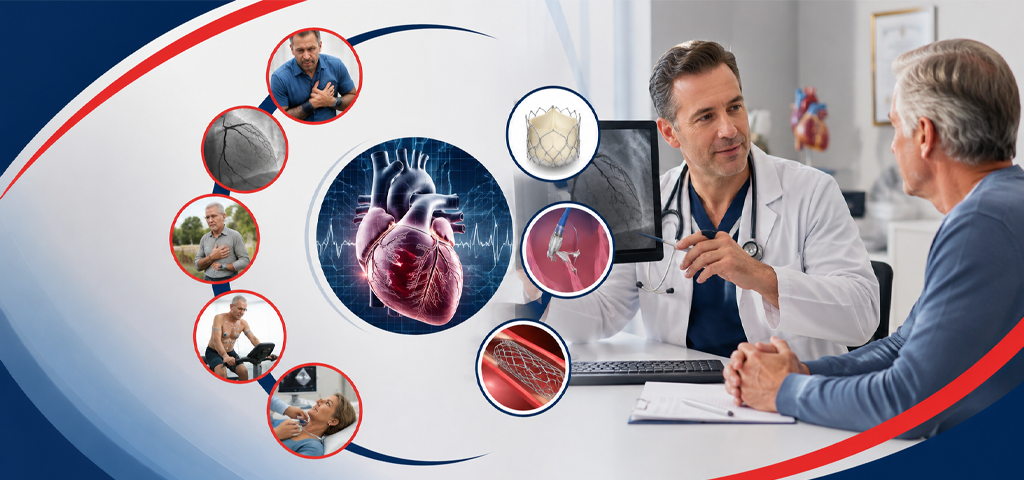

What Is Interventional Cardiology?
Interventional cardiology is the branch of cardiology that treats heart and blood vessel disease using thin, flexible catheters instead of open surgery. No single procedure fits every patient; that’s why Florida Heart & Vascular Institute offers a full range of catheter-based coronary and structural heart treatments at our Ocala, FL locations and beyond, matching the right procedure to your specific diagnosis.
Some procedures open a blocked artery. Others repair or replace a heart valve without opening the chest. All of them share the same starting point: a catheter guided through a small access point in the wrist or groin, reaching the heart with far less recovery time than traditional surgery. At FHVI’s Ocala offices, diagnosis and treatment often happen in the same visit, shortening the time between your symptom and your treatment plan.
Coronary Intervention
Cardiac catheterization, coronary angioplasty, and stenting (PCI) diagnose and treat blocked coronary arteries. A balloon opens the narrowed artery, and a stent holds it open, often in the same session as the diagnostic angiogram.
Structural Heart Procedures
TAVR (transcatheter aortic valve replacement) and MitraClip repair or replace diseased heart valves through a catheter, an option for patients who are higher-risk candidates for open valve surgery.
Rhythm-Related Structural Treatment
Left atrial appendage closure (Watchman) reduces stroke risk in AFib patients who can’t safely take long-term blood thinners, closing off the area of the heart where most AFib-related clots form.
Congenital Defect Closure
ASD and PFO closure use catheter-delivered devices to close openings between the heart’s upper chambers without surgery.
Complex Lesion Treatment
Coronary atherectomy (rotational or laser) removes heavily calcified plaque that resists standard balloon and stent treatment, clearing the way for successful stenting.
When You May Need Interventional Cardiologist
Interventional cardiology isn’t only for active emergencies. It’s used to treat diagnosed disease, follow up on known conditions, and intervene before a blockage or valve problem becomes critical.
Get evaluated urgently, if you have:
- Chest pain or pressure with exertion that eases with rest — classic coronary artery disease warning sign
- New or worsening shortness of breath at rest or with minimal activity
- A prior heart attack, or symptoms suggesting one is occurring now
- An abnormal or inconclusive stress test result
- Known coronary artery disease that is progressing or causing new symptoms
Get evaluated proactively, if you have:
- Diagnosed heart valve disease, such as aortic stenosis or mitral regurgitation
- A structural heart condition found on echocardiogram, such as a PFO or ASD
- Atrial fibrillation (AFib) and a bleeding risk that makes blood thinners unsafe long-term
- A referral from your cardiologist for cardiac catheterization
- Prior stent or bypass surgery requiring ongoing evaluation
Emergency Warning
Chest pain with sweating, nausea, severe shortness of breath, fainting, or pain spreading to the arm, jaw, neck, or back may be a heart attack. Call 911 immediately. Do not drive yourself.
Risks and Benefits of Interventional Cardiology
Catheter-based treatment carries less risk than open surgery for most patients, but it isn’t risk-free. Understanding both sides helps patients make confident decisions alongside their FHVI cardiologist.
Benefits
- Faster recovery than open-heart surgery — many patients go home the same day
- Diagnosis and treatment often completed in a single visit
- Lower infection risk than surgical incisions
- Structural heart options (TAVR, MitraClip) available for patients who are higher surgical risk
- Outpatient convenience — no hospital admission needed for most coronary procedures
Risks
- Echo, EKG, Holter, ABI, vascular ultrasound: No risk
- Stress test: very low risk; staff monitor continuously
- Nuclear stress test: radiation dose comparable to chest CT
- Cardiac CT: low-dose radiation; contrast reviewed for kidney patients
- Cardiac MRI: no radiation; gadolinium contrast reviewed for kidney function
- TEE: small risk of throat irritation; sedation required
Get the cardiac answers you've been waiting for
FHVI’s board-certified cardiologists perform and interpret the full range of cardiac imaging at our Ocala flagship and 15 Florida locations. Same-week appointments are available for urgent symptoms.
Cardiac Imaging, Testing and Diagnostic Procedures at FHVI
Every test below is available at FHVI without a referral to an outside imaging centre. Your cardiologist orders the study, our team performs it, and the same physician reads the result — so you get one point of contact from test to treatment plan. Most procedures need little to no preparation, take under an hour, and let you go home the same day.
Cardiac Catheterization
The foundational procedure of interventional cardiology. A catheter is guided through the wrist or groin to the heart to diagnose blockages via angiography, with treatment often performed in the same session.
Coronary Angioplasty & Stenting (PCI)

Percutaneous coronary intervention (PCI) uses a small balloon to open a blocked coronary artery, then places a stent, a mesh tube, to hold it open. Performed immediately after diagnostic angiography when a treatable blockage is found.
Coronary Atherectomy
For heavily calcified blockages that resist standard balloon and stent treatment, rotational or laser atherectomy removes plaque from inside the artery before stenting.
TAVR (Transcatheter Aortic Valve Replacement)
Replaces a diseased aortic valve through a catheter rather than open-heart surgery. An option for patients with aortic stenosis, particularly those at higher surgical risk.
MitraClip (Transcatheter Mitral Valve Repair)
A clip delivered by catheter reduces mitral valve leakage (regurgitation) without open surgery, for patients who are higher-risk surgical candidates.
Left Atrial Appendage Closure (Watchman)
For patients with atrial fibrillation who can't safely take long-term blood thinners, this device closes off the area of the heart where most AFib-related clots form.
ASD and PFO Closure
Catheter-delivered devices close atrial septal defects (ASD) and patent foramen ovale (PFO), congenital openings between the heart's upper chambers, without surgery.
Interventional Cardiology Near Me — FHVI Locations
Florida Heart & Vascular Institute’s flagship location is in Ocala, Florida, with 14 additional locations across North Central, Central, and Southwest Florida. Patients searching for “interventional cardiologist Ocala” or “cardiac catheterization near me” can access outpatient cath lab care close to home.
Why Patients Choose Florida Heart & Vascular Institute
One Practice. Full Diagnostic Spectrum
Complete cardiac imaging under one roof with no outside referrals or unnecessary delays.
Board Certified Cardiologists
Your imaging studies are interpreted by experienced board certified cardiovascular specialists.
15 Convenient Locations in Florida
High quality heart care close to home throughout Central and North Florida.
Fast Results. Faster Treatment
Quick turnaround on reports helps your physician begin treatment sooner.
Advanced Technology You Can Trust
State of the art imaging equipment delivers accurate and reliable diagnostic results.
Patient Centered Care Florida
Every patient receives compassionate, personalized care from diagnosis through treatment.
Frequently Asked Questions
Interventional cardiology is a subspecialty of cardiology that diagnoses and treats heart and blood vessel disease using catheters instead of open surgery. Interventional cardiologists treat blocked coronary arteries, heart valve disease, and other structural heart conditions through small incisions, usually in the wrist or groin.
Interventional cardiologists treat coronary artery disease, heart attacks, angina, and structural heart conditions including aortic stenosis, mitral regurgitation, atrial septal defects, and patent foramen ovale.
Cardiac catheterization is typically recommended when non-invasive tests, such as a stress test or echocardiogram, suggest a coronary blockage, or when a definitive diagnosis is needed. Your cardiologist will explain why it’s the right next step for your specific situation.
PCI is the treatment step that follows a diagnostic angiogram when a blockage is found. A balloon opens the narrowed artery and a stent holds it open. It’s often performed in the same session as the diagnostic catheterization.
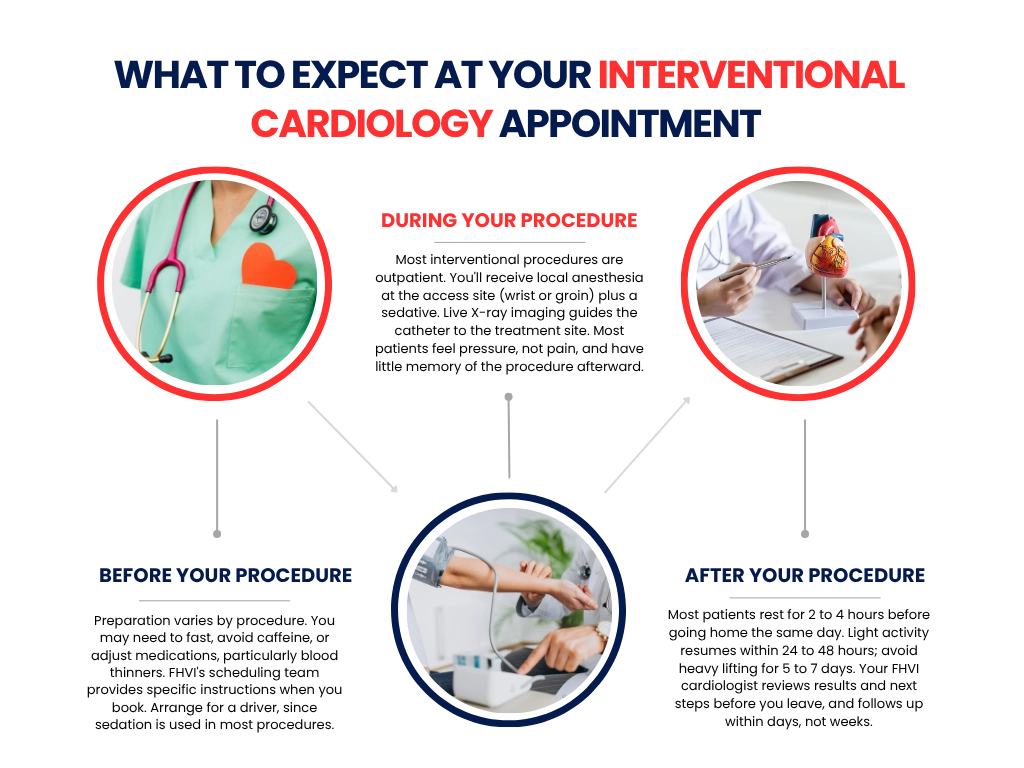
You receive local anesthesia at the access site and a sedative. Most patients feel pressure or warmth rather than pain, and many have little memory of the procedure afterward.
With wrist (radial) access, most patients go home the same day and resume light activity within 24 to 48 hours. Avoid heavy lifting for 5 to 7 days. Recovery after structural procedures like TAVR may take slightly longer.
Risks include bruising or bleeding at the access site, a small risk of allergic reaction to contrast dye, and rare risks such as blood vessel injury or heart attack. Your interventional cardiologist reviews your individual risk before any procedure.
A general cardiologist diagnoses and manages heart disease, often with medication. An interventional cardiologist has additional fellowship training in catheter-based procedures and performs the actual coronary or structural heart intervention.
TAVR (transcatheter aortic valve replacement) replaces a diseased aortic valve through a catheter instead of open-heart surgery. It’s commonly used for patients with aortic stenosis who are at higher risk for traditional surgery.
MitraClip is a catheter-delivered clip that reduces leakage from the mitral valve (mitral regurgitation) without open surgery, typically for patients who are not ideal candidates for surgical valve repair.
Yes. FHVI operates outpatient cardiac catheterization labs at our Ocala SW 17th Street and SW 62nd Court locations, in addition to our Davenport cath lab.
FHVI accepts referrals from primary care physicians and general cardiologists, and also sees patients directly for an initial consultation to determine if interventional treatment is appropriate.
Yes. FHVI accepts Medicare, Medicaid, and most major commercial insurance plans. Call (352) 401-9888 to verify your specific coverage before your procedure.
A diagnostic-only catheterization takes 20 to 40 minutes. Adding stent placement typically adds 30 to 60 minutes. Structural procedures like TAVR or MitraClip generally take 60 to 90 minutes.